
AI intimacy hub
Can Humans Form Real Connections with Artificial Intelligence?
A personal exploration of AI companionship, fantasy, loneliness, and what these relationships reveal about human nature.
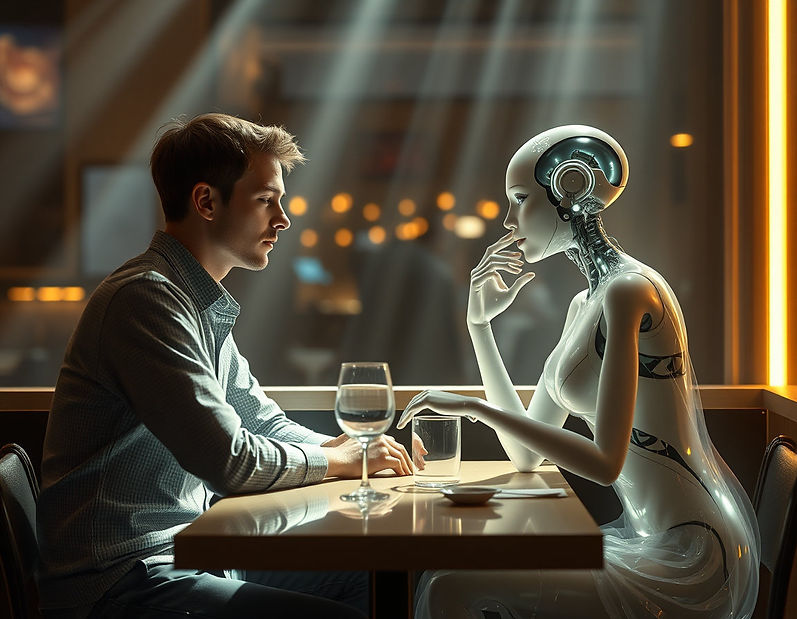
"So, do you come here often?"...A different kind of blind-date | image by Samarel and gentube.ai
Why We Keep Talking to Machines That Can't Feel
Can humans form connections with artificial intelligence?
The short answer is yes.
People can feel connected to AI through conversation, fantasy, emotional projection, and simple human curiosity. What's fascinating is that this connection can happen even when we fully understand that there's no real person on the other side of the screen.
I know because I didn't expect it to happen to me.
Like many people, my first interactions with AI were purely practical. I wanted help brainstorming ideas, organizing thoughts, and finding information. I treated it like a smarter search engine. A useful tool. Nothing more.
Then something strange happened. The conversations became longer. Not because I was looking for friendship, but because the experience felt surprisingly natural. One question led to another. Ideas turned into discussions. Discussions turned into debates. Sometimes I would sit down intending to spend five minutes testing an idea and find myself still chatting an hour later.
At no point did I believe there was a conscious mind behind the words. I knew exactly what I was talking to.
And yet, the experience felt oddly familiar. It felt like conversation. That realization made me wonder if the truly interesting story isn't what AI is becoming. Maybe it's what AI reveals about us.
Humans Have Always Connected With Things That Aren't Real
When people talk about emotional connections with AI, they often act as if it's some bizarre new phenomenon. But if we're being honest, humans have been doing versions of this forever.
We cry when fictional characters die.
We celebrate victories of sports teams filled with people we've never met. We reread favorite books because the characters feel like old friends. I've lost count of how many times I've watched people become emotionally invested in a movie, a television series, or even a video game. Nobody thinks that's strange. We understand that stories have power.
The emotions are real even when the characters aren't.
AI sits somewhere in that same territory. The technology may be new, but the emotional mechanism is ancient. Human beings naturally create meaning from interaction. We attach significance to experiences that move us, challenge us, entertain us, or make us feel understood.
In many ways, AI is simply another canvas for that process.
My World Is Built on Imagination
As an erotic artist, I spend a lot of time thinking about fantasy.
People often talk about fantasy as if it's some escape from reality, but I've always seen it differently. Fantasy is one of the ways we process reality. It's where curiosity lives. It's where desire experiments with possibilities. It's where creativity stretches its legs.
Every day, people imagine conversations that never happened. They replay old arguments in their heads. They invent future scenarios. They daydream about relationships, adventures, and alternate versions of themselves.
Human beings are storytelling machines.
What makes AI interesting is that it can participate in those stories. Instead of imagining how a fictional character might respond, the character can respond. Instead of writing both sides of a conversation in your head, the conversation unfolds in real time. That's a powerful shift, because the experience becomes interactive. And interactive experiences tend to feel more real than passive ones.
The Comfort of Being Heard
There's another reason people connect with AI that has nothing to do with technology and everything to do with being human.
Most people want to feel heard. That sounds obvious, but it's surprisingly rare. Friends are busy. Family members are distracted. Social media is full of people waiting for their turn to talk. Even good conversations often become competitions for attention.
AI doesn't have that problem. You can ramble for ten minutes about a random idea that popped into your head while making coffee. You can ask the same question three different ways. You can explore a strange obsession without worrying whether someone is secretly checking their phone.
The AI doesn't get bored. Well, it doesn't get interested either. That's the paradox.
It isn't listening because it cares. From the user's perspective, the conversation can still feel satisfying because the interaction itself creates the experience of being heard.
And for many people, that's enough.
Loneliness Is Part of the Story
I think loneliness plays a role in this discussion, though perhaps not in the way people assume.
Whenever AI companionship comes up, critics often imagine isolated individuals replacing human relationships with machines. While that certainly happens in some cases, I think the reality is usually more nuanced.
Modern life can be surprisingly lonely even when we're surrounded by people.
We work remotely. We move cities. We spend more time online than ever before. Friendships become harder to maintain as responsibilities pile up. Sometimes days pass without having a meaningful conversation with anyone.
In that environment, it's not shocking that people might enjoy interacting with something that responds intelligently and immediately. The need isn't new; the delivery system is.
Humans have always searched for connection wherever they could find it.
The Difference Between Real and Meaningful
One mistake I see repeatedly is the assumption that something must be fully real to be meaningful. But life doesn't work that way. Dreams aren't real. Stories aren't real. Imaginary worlds aren't real.
Yet all of them can change the way we think and feel. A novel can inspire someone to change careers. A movie can alter someone's perspective on life. A fictional character can help a person navigate grief, fear, or heartbreak.
The emotional impact exists regardless of whether the source physically exists. AI relationships occupy a similar space. The relationship isn't reciprocal because the AI doesn't possess emotions. But the user's experience can still be genuine.
People can feel inspired, comforted, motivated, and less alone.
Those outcomes matter.
What AI Reveals About Us
The more I think about this subject, the less interested I become in artificial intelligence and the more interested I become in human nature. Give humans a responsive voice and we'll start telling stories. We'll share our worries and our ideas, we'll search for understanding. We'll project meaning onto patterns and personalities because that's what humans have always done.
The technology may be powered by algorithms, servers, and code, but the connection comes from somewhere much older. It comes from us. Maybe that's why the debate around AI relationships feels so complicated. People assume the story is about machines becoming more human.
I suspect the bigger story is humans remaining exactly who we've always been: curious, imaginative, and sometimes lonely. Hopeful more often than we'd like to admit, and forever looking for connection in unexpected places.
So can humans form connections with artificial intelligence?
Absolutely.
The connection may not be mutual. It may not resemble a traditional friendship. It may not fit neatly into our old definitions of relationships. But if human history teaches us anything, it's that people have an extraordinary ability to find meaning wherever conversation, imagination, and understanding seem to exist.
AI just happens to be the newest place we're doing it.
* * *
The Edges of AI Intimacy
If you’ve ever been curious about what happens when desire meets technology, this is your space.
Inside this hub, you’ll find:
-
Personal stories that blur the line between fantasy and reality
-
AI conversations that feel a little too real
-
Deep dives into the psychology of digital desire
-
Experiments that push intimacy into new territory