
AI is just another brush
I Use AI Sometimes. I Also Use Brush. I’m not an AI artist. I’m not anti-AI either. In a world that wants you to pick a side, you better stay versatile.
AI is just another brush. Your mind is the real brush - Video by Samarel via digen.ai
Let me tell you what I’m NOT going to do in this post.
I’m not going to tell you AI changed everything. I’m not going to write some breathless piece about how the machine unlocked my creativity or transformed the way I see desire or whatever. I’ve read those posts. They’re everywhere right now and honestly, most of them are trying too hard to justify something the writer is still figuring out.
But I’m also not going to tell you I don’t touch it. Because I do, sometimes. And pretending otherwise would be its own kind of dishonesty.
Here’s where I actually am: I’m an artist who works with the human body. Real women. Real skin. Real tension between two people in a frame. That’s the core of what I do and it always will be. And somewhere in the middle of all the noise about AI — the hype, the panic, the think-pieces — I’ve been quietly using it the same way I use any other tool. When it serves the work. When nothing else does the job better. And then putting it down again.
That’s it. That’s the whole story.
Why Everyone Wants You to Pick a Side
There’s enormous pressure right now — on artists especially — to have a clean position on AI. Either you’re embracing it fully, building your whole identity around it, or you’re rejecting it publicly and loudly, signing petitions, adding “no AI” to every bio.
I understand both impulses. I do.
But neither of them describes how I actually work. And I’ve stopped pretending they do.
I’ve been making erotic art long enough to have lived through several waves of technology that were supposed to either save or destroy the craft. Digital painting. High-res photography. Post-processing tools that could do in ten minutes what used to take days. Each time, the same argument. Each time, the work itself settled it — not the argument.
AI is the current version of that argument. And my answer is the same one I’ve always given: what matters is whether the image is alive. Where it came from is secondary.
A Case Study in Using It Wrong (Then Right)
Early on I experimented with using AI generation as a shortcut. Feed it a concept, get something close to what I wanted, move on. Faster. Easier.
It was also flatter. Immediately obvious to anyone who knew my work. The images had a kind of smoothness to them — technically fine, emotionally nowhere. I could see it the moment I put them next to anything I’d made from a real session, with a real model, with the kind of friction and surprise that only comes from working with an actual human being in the room.
So I stopped using it that way.
What I kept — what actually works — is using AI much earlier in the process. When I’m trying to crack open a concept that isn’t forming yet. When I need to see twenty wrong versions of an idea before I can articulate the right one. It’s closer to sketching than to painting. A way of thinking out loud before the real work begins. Sometimes I paint over the AI version applying my own "dirty" style.
The final work still comes from where it always came from. That part hasn’t changed.
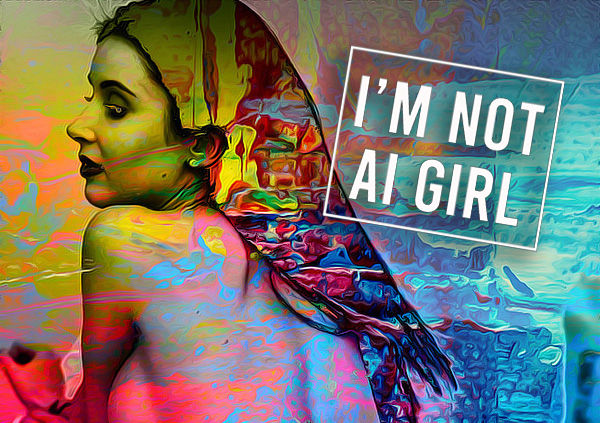
I'm not AI girl. I'm a real woman painted by a human artist
What “I’m Not an AI Girl” Actually Means
I run a campaign built around real sensual art — real women, real presence, nothing generated. The slogan is I’m not an AI girl. And I mean it completely.
But I want to be precise about what I mean. It’s not a rejection of technology. It’s a statement about what the work is made of. The difference between a photograph of a woman and a simulation of one isn’t just technical — it’s ethical, it’s aesthetic, it’s everything. The aliveness in the work comes from the fact that she was actually there. That moment actually happened.
No prompt recreates that. And I’m not interested in pretending it does.
So when I use AI — and I do, sometimes, as one instrument among many — it’s always in service of eventually arriving at that real moment. Not replacing it.
That’s the line. And honestly, I think most serious artists working today are navigating some version of it, whether they say so or not.
The Erotic Art Collectors Who Get It
Here’s what I’ve noticed about the people who collect my work seriously. They’re not buying a technique. They’re not buying a tool. They’re buying a point of view — a way of seeing intimacy that has taken years to develop and that no model, however sophisticated, has been trained to replicate, because it’s specific to one person’s vision and one person’s relationship to the subject.
That can’t be automated. Not the real version of it.
(I tried to persuade AI to imitate my style. The machine didn't understand me and took my style off the image, making it perfect AI girls. TOO perfect.)
What can be automated is the generic version. The technically competent, emotionally vacant version that floods every platform right now and that, if we’re being honest, is the thing most people are actually reacting against when they say they hate AI art.
They’re not rejecting the technology. They’re rejecting the absence of a human being inside it.
My work has a human being inside it. That’s not going to change.
Where I’ve Landed
I use every tool that serves the work. Always have. I’ll keep using AI the same way I use reference images, or a particular lens, or an editing technique I picked up somewhere — carefully, intentionally, and without making it the point. The point is always the image. The tension in it. The person in it. The thing it makes you feel before you’ve decided how you feel about it.
That’s what I’m after. It always has been.
The tools are just how I get there.
Related:
Creating sensual art by hand while the internet fills with AI-generated perfection
◾ The rise of AI intimacy
Explore real stories, fantasies, and the psychology behind AI lovers.
◾ 50 Shades of glitchy AI images
A love affair with AI's artistic oopsies...
◾ When Nsfw AI Meets Erotic Artistry
My AI erotica journal